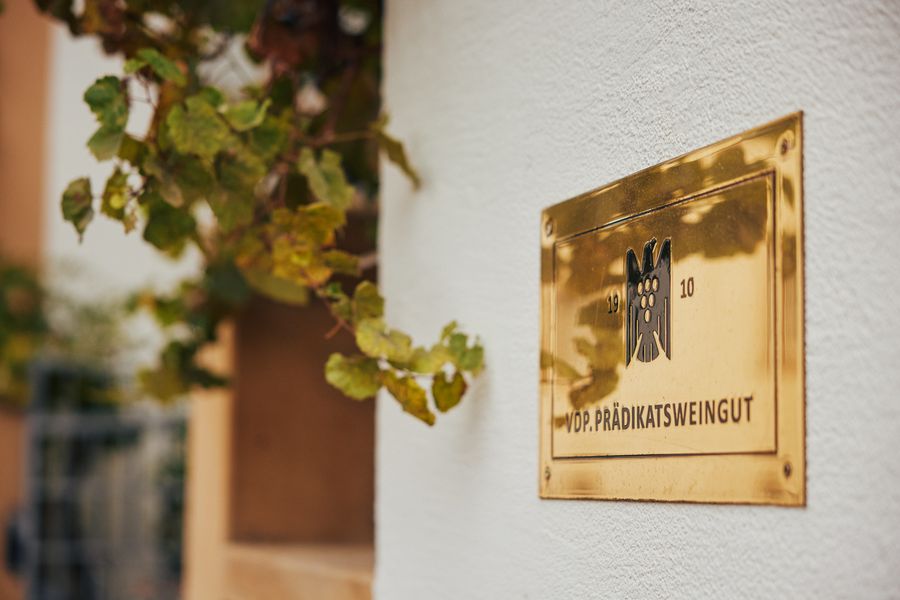




For a century, the VDP.Eagle has accompanied
the VDP through changing times.
The Brandenburg eagle was bathed in deep red, the Prussian one wore black, while the Habsburg heraldic symbol even took the form of a double-headed eagle. Over the centuries, many things adorned the chests of these imposing heraldic birds – but never grapes. That was about to change in the mid-1920s.
Of course, the circumstances were hardly favourable for German wine in the aftermath of the First World War. Even natural wine was struggling to make its mark, despite the almost 200 members of the Verband Deutscher Naturweinversteigerer (VDNV) being firmly committed to upholding its reputation.
Four regional associations of wine estates, whose white wines ranked among the finest and most expensive in the world, had founded the umbrella organisation in 1910 – not, however, out of any particular affection for one another. Quite the opposite. But with economic prospects looking increasingly bleak, they at least wanted to put an end to competing with one another over the dates of their natural wine auctions.
The Origins: Wine Auctions
Another priority was to join forces in resisting the demands of the wine trade. The trade would have loved to bottle the natural wines itself and market them as “original bottlings”. The natural wine auctioneers were determined not to let that happen. For customers to be certain, in a wine world rife with fraud and forgery, that these fine wines had not been blended with other vintages or falsely labelled with an origin their contents did not justify, they had to be bottled in the producers’ own cellars and under their direct supervision.
Both objectives were fully achieved. From 1911 onwards, the regional associations generally coordinated the periods during which their members auctioned their finest wines, either individually or jointly. The wine trade, meanwhile, lost interest in the idea of “original bottlings”, as the natural wine auctioneers’ exclusive right to bottle their own wines was confirmed by the new Wine Act passed by the Reichstag in 1911.
Years of Crisis: The 1920s
Even without the wine tax introduced in the final year of the war, the mid-1920s were marked by crisis in many parts of Germany. Since 1921, not a single vintage had been produced in sufficient quality for the majority of the wines stored in the cellars of VDNV members to qualify as “independent” and therefore eligible for auction. The wine trade had lost much of its capital during the hyperinflation of 1923. The same was true of many members of the business and educated middle classes, who for decades had remained devoted to pure Rieslings from the Rhine and its tributaries.
Was this really reason enough to throw in the towel after just 15 years? Morale among VDNV members was low, although most were probably still in a considerably better economic position than the many lesser-known producers, particularly along the Mosel. Following the third poor harvest in a row, it was no longer a question of whether unrest among winegrowers would erupt in 1925, but when.
The question of “when” occupied the natural wine auctioneers in another respect, too. The association had neither an overview of its membership nor had it ever made an effort to create an emblem that would visibly identify membership in this group of Germany’s finest wine producers. Thus, the minutes of the Association Committee meeting on 12 December 1925 recorded the following under item 3, in a prominently highlighted paragraph:
“Membership is open only to associations of natural wine auctioneers whose statutes expressly stipulate that only naturally pure wines from their own vineyards may be auctioned or sold privately.”
A New Emblem for the Association
Yet while there was no shortage of determination in one area, there was considerable uncertainty in another. Under agenda item 4, “Association Emblem”, the minutes recorded: “The designs submitted were not approved.” This was followed by the note: “Mr von Bassermann-Jordan undertook to contact a heraldic expert regarding a design.”
Unfortunately, we do not know what Friedrich von Bassermann-Jordan, who had risen to become the leading figure in Palatinate viticulture following the death of his brother Ludwig in August 1914, did to advance the matter. But by 20 February 1926, Bruchhausen, as chairman of the VDNV, was already seeking approval for several innovations at an extraordinary meeting of the Association Committee.
First, the association was to be entered in the register of associations at the Trier District Court – something that apparently had not been done in 1910. Second: “The newly created association emblem is to be submitted for registration in the trademark register of the Reich Patent Office.”
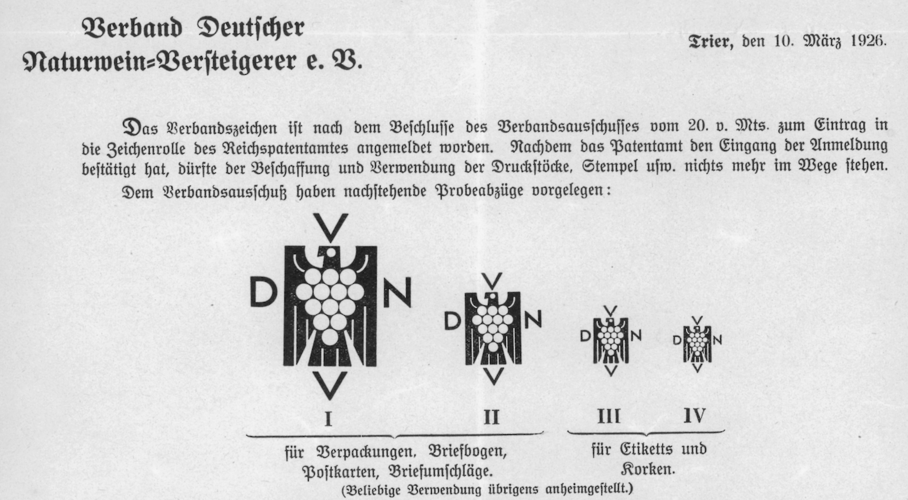
Indeed, the Reich Patent Office gave its approval for the use of the new emblem as early as the beginning of March. On 10 March 1926, the association’s managing director, Schneider, sent all members a document containing the proof prints that had been presented in February. In four different sizes, with two versions each – one for use on packaging, letterheads, postcards and envelopes, and the other for labels and corks – it depicted a black eagle, rendered in strict heraldic style, facing right (or left from the viewer’s perspective). Its breast shield was adorned with a total of 13 grapes.
The Origins of the VDP.Eagle
The surviving documents do not reveal how everything came together in the space of just a few weeks. However, several clues are worth following. The first leads to Koblenz, back to the summer of 1925. Seven years after the end of the Great War, the city hosted a “Reich Exhibition of German Wine”, as the Rhineland was said to have been part of Germany for exactly a thousand years.
An otherwise little-known Cologne poet named Franz-Josef Lichtenberg saw a business opportunity in the exhibition. He composed a patriotic, rather grandiose “dedication verse”, printed it on a large-format wall poster and placed above it an Imperial Eagle, slightly reimagined in an Expressionist style. Its breast shield featured an abundant cluster of 13 grapes, complete with vine leaves. The idea was to adorn thousands of walls in universities, grammar schools and primary schools, while distributing countless postcards to the public.
We do not know how successful the campaign proved to be. But when the Trier-based painter and graphic artist Fritz Quant set about designing an emblem for the VDNV towards the end of 1925, he was most likely inspired by Lichtenberg’s creation.
The estate of the artist, who died in 1933, contains two designs. One depicts a grape eagle in orange, bearing the initials VDNV and featuring wings that taper towards the top, presumably to give it a sense of dynamism. The second design shows the strictly symmetrical heraldic eagle that was ultimately chosen in black.
Sixteen years after its foundation, the VDNV had found its emblem in the VDP.Eagle: a symbol destined to soar above the everyday and weather every storm, unscathed.
Early Attempts
First, however, the heraldic bird had to learn to fly – quite literally – by winning over the member estates. The association led by example. Following its registration with the Reich Patent Office, the VDP.Eagle featured on the cover of the first membership directory, published in spring 1926. The second page stated: “Members of the association’s regional organisations are entitled to display the newly created association emblem shown below on documents, packaging, bottle labels and corks as proof of their membership in the association and the natural purity of their wines.”
What the document did not mention was that the association emblem was never intended to replace the seals of the individual member associations. Nor could the 216 members be required to adopt the VDP.Eagle – not least because the by far largest estates were subject to regulations other than those of the VDNV. As state-owned wine estates in the Rheingau and along the Mosel, Saar, Nahe and Ahr, the Prussian domains promoted their wines using the Prussian Imperial Eagle. The elaborately designed bottle labels of traditional estates such as Bassermann-Jordan in the Palatinate and Langwerth-von Simmern in the Rheingau likewise left little room for any additional decoration.
At a meeting of the Association Committee on 27 September 1929, even before the outbreak of the Great Depression, the idea of commissioning a uniform bottle label was therefore discussed as a means of strengthening the association’s public image. Clearly, Richard Count Matuschka-Greiffenclau, a Prussian government councillor, owner of Schloss Vollrads and chairman of the Rheingau Winegrowers’ Association, had presented ideas on how to promote wine. And so, on 2 February 1930, the chairmen of the regional associations expressed their intention “to create a uniform bottle label for the members of the associations”.
The Challenge of Unity
Yet, as so often, not all members shared the majority’s view. This time, two regional associations voiced their opposition. The Rheingau Association of Wine Estate Owners reported that “a small number of its members remained opposed to a common bottle label”. From the Rheinpfalz came the news that the majority of members wished to retain their own individual labels. Their reasoning was that “the wine drinker only sees the label once the bottle is on the table” – implicitly suggesting that they saw little benefit in the VDNV estates presenting a united front. In the end, however, all associations except the Rheinpfalz agreed to have designs for a common bottle label drawn up.
The VDNV members had already considered what the label should feature as a minimum. First, the VDP.Eagle, as the association’s legally protected emblem, was to take centre stage. Second, it had to indicate that the wine was naturally pure and produced by a member of the association.
"With the VDP.Eagle,
the VDP has created an internationally
recognised trademark for
fine wine from Germany."
Dr. Daniel Deckers, journalist, editor and author
At a meeting in Koblenz on 12 June 1930, the chairmen of the member associations reviewed several designs and unanimously agreed that the proposal by Ernst Böhm should be adopted. Böhm was a renowned commercial artist and painter from Berlin. His design featured a vertical side panel displaying the VDP.Eagle, the association’s name and two slogans used by the VDNV. The first read: “Our members own vineyards of worldwide renown.” The second: “This emblem, together with the branded cork, guarantees naturally pure wine.” The adjacent white space was reserved for the name and coat of arms of the individual estate, as well as details of the wine itself.
At the meeting of the Association Committee held in Bad Dürkheim on 26 September 1930, the matter was finally settled. Without any further debate, the committee unanimously agreed that the bottle label should be introduced. The regional associations were now to encourage their members to adopt it.
In October 1930, Bruchhausen sent out a circular informing all members of this second, almost even more revolutionary step towards creating a brand under the name VDNV. The blank label enclosed with the letter was intended, above all, to “draw the wine drinker’s attention to the estate and the association more than ever before”. He went even further, expressing the hope that, once the label had become sufficiently established, wine lists and price lists might also feature the designation “Verband Deutscher Naturweinversteigerer” alongside the producer’s name. An ambitious vision that was never to become reality.
It is difficult to establish which estates followed the chairman’s request and adopted the new bottle label. The surviving records contain no statistics documenting the use of either the distinctive label or the VDP.Eagle itself. However, all evidence suggests that, by the time the VDNV was re-established as the Verband Deutscher Prädikatsweinversteigerer(VDPV; 1971–1974) and subsequently as the VDP, at most one third of its member estates had ever identified themselves as members through the use of the VDP.Eagle or the association’s bottle label.
The Eagle as a Unifying Symbol
Despite repeated appeals to the members’ sense of solidarity, little changed until the 1990s. This was all the more remarkable given that, following the 1971 Wine Act’s prohibition of the term “natural wine” and the end of the auctions, the VDP.Eagle had become the only link connecting the VDP to its past.
Nevertheless, presidents Peter von Weymarn (Weingut Heyl zu Herrnsheim, Rheinhessen; 1972–1980) and Erwein Graf Matuschka-Greiffenclau (1980–1989) succeeded in containing the many centrifugal forces within the association with the help of the Eagle. It stood for quality as well as international recognition.
A Breakthrough for the Eagle: The First Wine Fair in Mainz
A characteristic feature of the period following the association’s reorganisation was Peter von Weymarn’s attempt in 1976 to dispel concerns about the VDP taking over the Rheinhessen Riesling Exchange. The new Mainz Wine Exchange, the president explained, was intended to be “an event fundamentally open to all our members”. To flesh out this vision, he noted down a few key ideas: “balancing interests, overcoming regional thinking in marketing, pooling promotional strength”. It was therefore “completely wrong for some to think this means a new grouping”, Weymarn argued. “No, it is a public platform from which everyone benefits, because the Eagle reigns above all.” A rhetorical flourish, albeit one that was somewhat less polished in writing.
When the doors of the Electoral Palace in Mainz opened for the first Mainz Wine Exchange from 11 to 13 May 1976, the cover of the catalogue duly featured the very same VDP.Eagle that had first seen the light of day in Trier almost exactly fifty years earlier. From this prominent position, the Eagle would never again be displaced.
Over the years, however, the bird’s austere black appearance was to change. In 1989, Michael Prince zu Salm-Salm (Schloss Wallhausen, Nahe) succeeded Erwein Graf Matuschka-Greiffenclau as VDP president and set about a comprehensive process of revitalisation. At the members’ meeting on 30 May 1990, Salm made it clear that he considered it essential for the association to “hold our VDP.Eagle high” at every suitable opportunity. But what should it look like? One of his initiatives was to give the Eagle a more lively and approachable appearance.
“Also new is the redesign of the association’s famous eagle logo,” the president was quoted as saying in Drinks International in September 1991. Salm continued: “We didn’t want to throw it away.” By then, it had become far too recognisable.
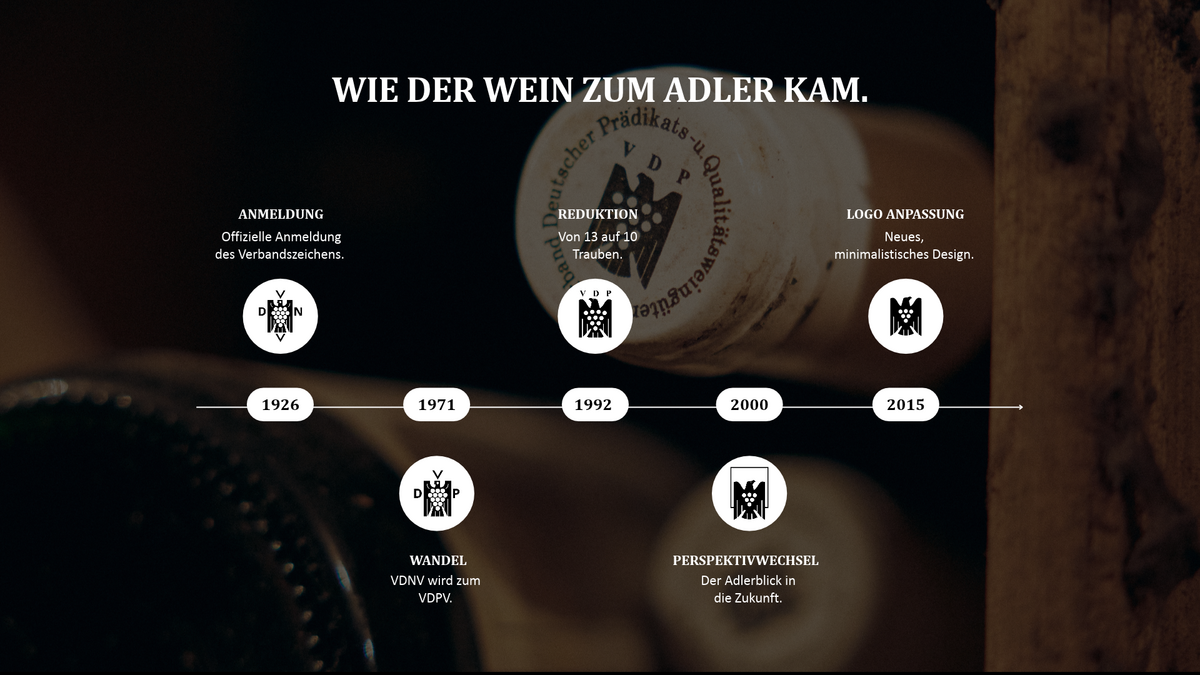
The first step was a redesign: “We just recrafted it. It was a bit too martial; we felt it should be a little more peaceful and positive.” Its wings were slightly shortened, its tail feathers rounded, and its head was no longer rigidly aligned within a symmetrical framework and facing straight to the right. Instead, it was tilted upwards, gazing towards the sky. In 1991, the VDP.Eagle emerged more dynamic than ever, not only in appearance but also in its ability to take flight. Its breast now featured just ten grapes instead of thirteen.
The second step proved more challenging. The idea that all member estates would demonstrate their affiliation with the VDP by using the 1930 bottle label had always been more of a dream than a reality. Salm and the association’s marketing committee came up with a better solution: why not place the Eagle on the capsule, as had briefly been considered in the early 1970s? Reaching agreement on this was by no means easy. “Good growers are always very individualistic,” Prince Salm was quoted as saying. “It wasn’t easy to persuade them to give up their own logos.”
The archived records available today do not reveal exactly what proportion of estates adopted the capsule featuring the VDP.Eagle, literally placing the symbol around the neck of their bottles, or when they did so. However, acceptance of the new capsule appears to have surpassed that of the standardised bottle label introduced in the 1930s within a relatively short time. In 1993, Drinks International reported: “Launched in spring 1991, the capsule is now featured on 50% of the bottles marketed by the 169 estates, and this is rising rapidly, as old stocks of capsules are used up and older vintages disappear from the shelves.”
Blick gen Zukunft
Nearly 25 years have passed since the VDP.Eagle first took its place on the capsules of bottles produced by the VDP’s approximately 200 member estates. Today, more than ever, it serves as both a marker of identity and a symbol of belonging. And it does so with greater ease than ever before. While the Eagle had already shed much of its solemn, stern expression from 1926 during Michael Salm’s presidency, the emblem underwent a further refresh under his successor, Steffen Christmann (Gimmeldingen, Palatinate). The heraldic bird was quite literally given a new direction: its head was turned around. For more than twenty years now, the VDP.Eagle has been looking to the right from the viewer’s perspective – towards the future.